
How to Calculate a Yearly Revenue Goal as a Freelancer

Most freelancers do not have a revenue goal. They have a hope. "I want to make six figures" or "I need to earn more than last year." But without a specific number tied to real expenses, taxes, and desired lifestyle, you are guessing. And when you are guessing, you cannot know whether your rates are right, whether you are on track, or whether you can afford to take a vacation.
A yearly revenue goal changes everything. It turns "I hope I make enough" into "I need to bill $X this month to stay on pace." It is the difference between reacting to your finances and managing them.
Here is how to calculate yours.
Step 1: Start With Your Desired Take-Home Pay
This is the amount you want to deposit into your personal bank account after all business expenses and taxes. It is not your revenue. It is what you actually live on.
Think about what you need to cover:
- Rent or mortgage
- Groceries and household expenses
- Car payment, insurance, gas
- Health insurance (if not covered by a spouse's plan)
- Savings and retirement contributions
- Kids, childcare, education
- Entertainment, travel, personal spending
- Emergency fund contributions
Add it all up. Be honest. If you need $6,000/month to live the way you want, your target take-home is $72,000/year.
Step 2: Add Your Business Expenses
Your business has costs that come out before you take home anything:
- Software subscriptions (project management, time tracking, invoicing, design tools)
- Hardware and equipment
- Office space or coworking membership
- Internet, phone
- Professional development (courses, conferences, books)
- Accounting and legal fees
- Insurance (professional liability, E&O)
- Marketing and advertising
- Subcontractor payments
Add up your total annual business expenses. For many solo freelancers this is $5,000-$15,000/year. For agencies or teams, it can be much more.
Step 3: Account for Taxes
As a freelancer, you pay both income tax and self-employment tax (Social Security and Medicare). Self-employment tax alone is 15.3% on your net income. Combined with federal and state income tax, most freelancers pay an effective rate of 25-35%.
A conservative approach: multiply your desired take-home pay by 1.35 to 1.45 to estimate the gross income needed before taxes.
Example: $72,000 take-home x 1.40 = $100,800 pre-tax income needed.
Step 4: Calculate Your Revenue Goal
Your yearly revenue goal is:
Take-home pay + Business expenses + Taxes = Revenue Goal
Using our example:
- Take-home pay: $72,000
- Business expenses: $10,000
- Tax adjustment: $72,000 x 0.40 = $28,800
- Revenue goal: $110,800
That is the number your business needs to bring in this year for you to live the way you want, cover your business costs, and pay your taxes without surprises.
Step 5: Factor In Time Off
This is the step most freelancers skip, and it is the one that makes or breaks your pricing.
How many weeks do you want to take off this year? Include:
- Vacation
- Holidays
- Sick days
- Personal days
- Days you simply will not be productive
Most people need 4-6 weeks off per year (including holidays and sick time). That leaves 46-48 working weeks.
Now calculate your available billable hours. Not every working hour is billable. You spend time on admin, marketing, invoicing, sales calls, and email. A realistic ratio is 60-75% billable time.
Example:
- 47 working weeks x 40 hours = 1,880 total hours
- 70% billable = 1,316 billable hours
Step 6: Determine Your Required Rate
Divide your revenue goal by your billable hours:
$110,800 / 1,316 hours = $84.19/hour
That is the minimum hourly rate you need to charge to hit your goal. If you are charging less than that, you will either miss your income target or work more hours than planned.
For project-based pricing, this number tells you how to price projects. A project you estimate at 40 hours needs to be priced at minimum $3,368 to stay on track.
Step 7: Break It Down to Monthly and Weekly Targets
A yearly goal is useful for planning. Monthly and weekly targets are useful for execution.
- Monthly target: $110,800 / 12 = $9,233/month
- Weekly target: $110,800 / 47 working weeks = $2,357/week
Now you have a number you can check against every week. Am I on pace? Am I ahead? Am I behind? This is the information that lets you make real-time decisions about taking on more work, raising rates, or adjusting your spending.
The Goal Calculator
If you want to skip the manual math, Harpoon's Yearly Revenue Goal Calculator does all of this for you. Enter your personal budget, business expenses, and desired time off, and it calculates your revenue goal, monthly target, and required hourly rate.
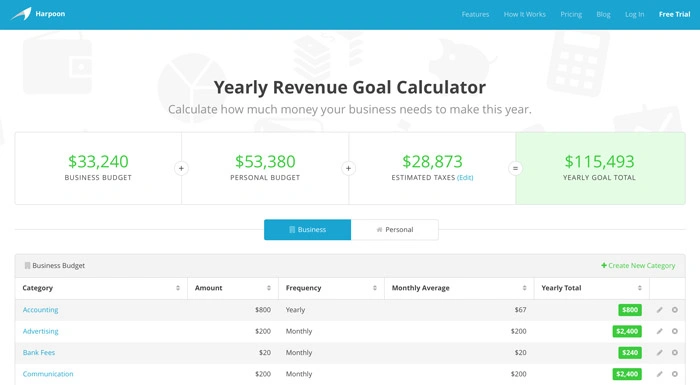
Inside the Harpoon app, your revenue goal is not just a number on a spreadsheet. It is connected to your invoicing, time tracking, and project management. You see a real-time progress bar showing how close you are to your annual goal, broken down by month. When you are ahead, you know you can take that vacation. When you are behind, you know before it is too late to course correct.
What to Do With Your Number
Once you have your revenue goal, use it to drive three decisions:
1. Set your rates with confidence. If your required rate is $85/hr and you are charging $60/hr, you now have a concrete reason to raise your rates. It is not about "wanting more money." It is about hitting a target that supports your life.
2. Evaluate every project. Before accepting a project, check whether the price divided by your estimated hours meets or exceeds your required rate. If it does not, either negotiate the price up, reduce the scope, or decline. See our guide on responding to "your price is too high".
3. Track your progress throughout the year. A goal without tracking is a wish. Review your revenue against your target monthly. If you are falling behind in Q2, you have Q3 and Q4 to adjust. If you wait until December to check, it is too late.
Common Mistakes
Setting a round number with no math behind it. "$100,000" sounds good but may be $20,000 too low or $30,000 too high for your actual needs. Do the math.
Forgetting taxes. Your revenue is not your income. A $100,000 revenue year might mean $65,000 in take-home pay after taxes and expenses. If you need $80,000 to live on, you missed your goal by $15,000.
Assuming 40 billable hours per week. Nobody bills 40 hours a week, every week, for 50 weeks. Between admin, sales, sick days, and slow periods, 25-30 billable hours per week is realistic for most solo freelancers.
Not adjusting yearly. Your expenses change, your lifestyle changes, your tax situation changes. Recalculate your goal every January.
Further Reading
- How to Use Price Bracketing to present pricing that supports your revenue goal
- The Hybrid Approach to Pricing for structuring project fees
- Tax Deductible Expenses for Freelancers to reduce the tax portion of your goal
- Planning for Retirement as a Freelancer to factor retirement savings into your budget