
Tax Deductible Expenses for Freelancers and Small Businesses (2026 Guide)
One of the best parts of running your own business is the ability to deduct expenses from your taxable income. Before running my own business, I would often hear people say:
"It's expensive, but that's okay, it's deductible."
What exactly does that mean? A deductible expense is something you purchase in order to run your business, and you do not have to pay taxes on the money you spent on that item. This is different from a tax credit, which is a dollar-for-dollar subtraction from the taxes you owe. A deduction reduces your taxable income, which depending on your tax bracket, saves you roughly 20-35 cents for every dollar deducted.
For example: if you earn $100,000 and have $20,000 in deductible expenses, you are only taxed on $80,000. At a 24% tax rate, those deductions saved you $4,800.
The key to keeping more of what you earn is claiming every deduction you are legally entitled to. Here is a comprehensive guide to what freelancers and small business owners can deduct.
What You Cannot Deduct (Common Mistakes)
Before we cover what is deductible, here are expenses that freelancers commonly assume are deductible but are not:
- Your daily commute. Gas and mileage to and from a regular office or coworking space are not deductible. Driving to client meetings, conferences, or supply runs is deductible. Your commute is not.
- Coffee while you work at a coffee shop. Expenses you would normally pay for yourself, regardless of work, are not deductible. If you buy a client coffee, that is a business expense. Your own latte is not.
- Meals you eat alone during work hours. A 1953 court case (Sutter v. Commissioner of Internal Revenue) established that you cannot deduct ordinary meal expenses just because you were working at the time.
Now for the good news. There is a lot you can deduct.
Home Office Deduction
If you work from home, you can deduct a portion of your rent or mortgage, utilities, and insurance based on the percentage of your home used exclusively for business.
There are two methods:
Simplified method: Deduct $5 per square foot of your home office, up to 300 square feet. Maximum deduction: $1,500. No receipts needed.
Regular method: Calculate the actual percentage of your home used for business and apply that percentage to your housing costs (rent/mortgage interest, property taxes, utilities, insurance, repairs). This requires more record-keeping but often results in a larger deduction.
To qualify, your home office must meet three criteria:
- Exclusive use: The space is used only for business, not as a guest room or playroom. A spare bed in your office disqualifies it unless there is a clear partition.
- Regular use: You use the space consistently for business, not occasionally.
- Principal use: It is your primary place of business. If you pay for a separate office and work there most days, the home office does not qualify.
If you freelance on the side while holding a day job, your home office can still qualify as the primary location for the freelancing business. The deduction applies against your freelancing income.
Travel and Mileage
Business travel is one of the most valuable deductions for freelancers. This includes:
- Miles driven for client meetings, supply runs, conferences, and site visits
- Flights, hotels, and car rentals for business trips
- Parking fees and tolls (but not parking tickets)
- Rideshare fares for business trips
Mileage rate: The IRS sets a standard mileage rate each year. For 2026, check the current rate at irs.gov. For context, the rate has been in the range of 67-70 cents per mile in recent years. At 67 cents per mile, a freelancer who drives 8,000 business miles per year deducts over $5,300.
Harpoon makes it easy to track your mileage throughout the year. Even small trips add up, so log them as they happen rather than trying to reconstruct them at tax time. For more on this, read our guide on tracking your mileage as a freelancer.
Mixed travel: If you combine business and personal travel, the rules depend on the primary purpose of the trip. If the trip is primarily for business, you can deduct travel costs (flight, hotel) but not personal activity expenses. If business days are separated by a weekend, the weekend counts as a business day.
Example: You fly to meet a client on Friday and have a follow-up meeting on Monday. Thursday is a travel day (deductible), Friday is business (deductible), the weekend counts because you need to be there Monday (deductible), and Monday is business (deductible). If you stay through Wednesday for personal reasons, you have 5 business days and 2 personal days, so you can deduct about 5/7 of your travel costs.
If personal days exceed 25% of the trip, you may not be able to deduct your travel costs to the destination at all.
Equipment and Technology
Computers, monitors, cameras, phones, tablets, software subscriptions, and other equipment used for your business are deductible.
Section 179 deduction: Under Section 179 of the IRS code, you can deduct the full cost of qualifying equipment in the year you purchase it, rather than depreciating it over several years. The deduction limit is generous (over $1 million), so most freelancer purchases qualify for full immediate deduction.
If you use a device for both business and personal purposes, you can deduct the estimated business-use percentage. A laptop used 80% for business is 80% deductible.
Software and Subscriptions
Monthly and annual subscriptions to tools you use for business are deductible:
- Project management tools
- Time tracking and invoicing software (like Harpoon)
- Cloud storage and backup services
- Design, development, and productivity tools
- Communication tools (Slack, Zoom, etc.)
- Domain names and web hosting
Health Insurance Premiums
If neither you nor your spouse are eligible for an employer-subsidized health plan, you can deduct 100% of the premiums you pay for health, dental, and vision insurance for yourself, your spouse, and your dependents. This is one of the largest deductions available to self-employed individuals.
This deduction is taken on your personal tax return (Form 1040), not on Schedule C, and it cannot exceed your net self-employment income.
Retirement Contributions
Freelancers have access to several tax-advantaged retirement accounts with higher contribution limits than a traditional IRA:
- SEP IRA: Contribute up to 25% of net self-employment income
- Solo 401(k): Employee contributions plus employer contributions can be substantial
- Traditional IRA: Contributions may be tax-deductible depending on income
Retirement contributions reduce your taxable income now and grow tax-deferred. For a deeper dive, read our guide on planning for retirement as a freelancer.
Professional Development
Books, courses, conferences, workshops, certifications, and coaching programs that help you become better at running your business are deductible. This includes travel to conferences (airfare, hotel, registration fees).
Unpaid Invoices
If a client does not pay, can you deduct the lost income? Only partially. You can deduct the portion of an unpaid invoice that covers tangible goods or subcontractor costs. You cannot deduct your own unpaid time. If you bill 40 hours at $100/hr and the client never pays, the $4,000 of your time is not deductible. But if you paid a subcontractor $500 and bought $200 in materials for the project, those $700 in out-of-pocket costs are deductible.
The Complete Deduction Checklist
Here is a quick-reference list of common freelancer deductions:
| Category | Examples |
|---|---|
| Advertising and Marketing | Website hosting, business cards, social media ads, Google Ads, sponsorships, portfolio site |
| Bank Charges | Monthly service fees, foreign transaction fees, merchant processing fees, ATM fees |
| Business Insurance | Professional liability, errors and omissions, general liability |
| Business Licenses | State and local business license fees, professional association dues |
| Contracted Services | Subcontractor payments, virtual assistant fees, bookkeeper, accountant |
| Education | Courses, books, conferences, coaching, certifications |
| Equipment | Computer, monitor, desk, chair, camera, printer (Section 179) |
| Home Office | Percentage of rent/mortgage, utilities, insurance, repairs |
| Insurance Premiums | Health, dental, vision (self-employed deduction) |
| Internet and Phone | Business-use percentage of cell phone and home internet |
| Mileage and Travel | IRS standard mileage rate, flights, hotels, rental cars, parking |
| Office Supplies | Paper, ink, pens, notebooks, anything consumed in business operations |
| Postage and Shipping | Mailing invoices, shipping client deliverables, thank-you cards |
| Retirement | SEP IRA, Solo 401(k), Traditional IRA contributions |
| Repairs | Equipment repairs, office maintenance |
| Self-Employment Tax | You can deduct the employer-equivalent portion (50%) of self-employment tax |
| Software | SaaS subscriptions, design tools, accounting software |
Keeping Track of Your Expenses
Knowing about deductions is only useful if you keep accurate records. A few practices that make tax time painless:
Use a dedicated bank account or credit card for business expenses. This creates a clean paper trail and separates business spending from personal spending.
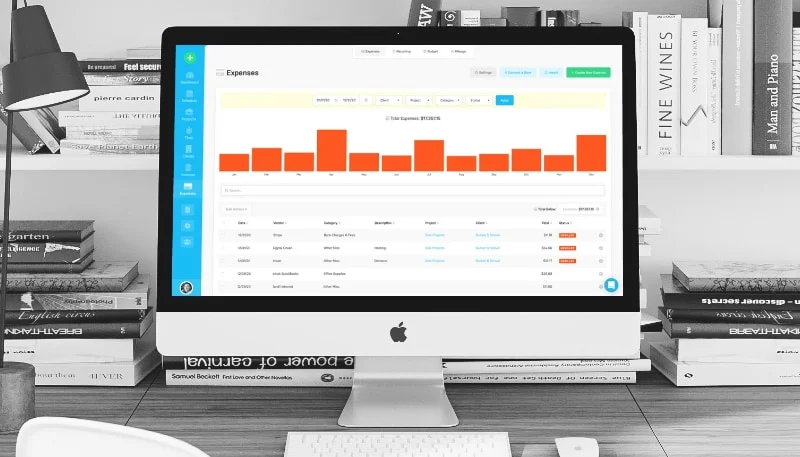
Import expenses automatically. Tools like Harpoon can import your expenses from a connected bank account or credit card, categorize them, and generate reports at tax time. No shoebox of receipts required.
Save receipts digitally. Harpoon lets you upload and attach receipt images to each expense. This is your backup if the IRS ever asks for documentation.
Set an expense budget. Knowing what you plan to spend in each category helps you make purchasing decisions throughout the year. Harpoon's expense budgeting lets you set targets and track spending in real time.
Review expenses quarterly. Do not wait until April. A quick quarterly review catches missing entries and helps you estimate your quarterly tax payments more accurately.
The Bottom Line
IRS audits exist because people bend the rules. As long as your expenses are legitimately used to run a business and are not mixed with personal use, you can safely deduct them. In the event of an audit, you will want clear records of your purchases and may need to provide receipts or other documentation.
Keep track of everything, even the small expenses. The difference between freelancers who owe thousands at tax time and those who get refunds often comes down to how diligently they track their deductions throughout the year.
For more on managing the financial side of freelancing, read about what to hand your accountant at tax time, tracking mileage, and setting a yearly revenue goal so you know what you need to earn after expenses and taxes.
Disclaimer: Harpoon and its affiliates do not provide tax, legal, or accounting advice. This material has been prepared for informational purposes only, and is not intended to provide, and should not be relied on for, tax, legal, or accounting advice. You should consult your own tax, legal, and accounting advisors before engaging in any transaction.